



By Sister Kate, Founder of Sisters of the Valley
November 20, 2026
Willie Nelson has spoken out against the federal hemp restrictions scheduled to take effect on December 11, 2026. His appeal draws attention to the veterans, seniors, patients, farmers, and small businesses whose lives and livelihoods could be disrupted by this legislation.
We’re taking our cue from Willie. For nearly twelve years, the Sisters of the Valley have been making plant-based products on our small farm in California. We have customers around the world who have shared stories about how our products have helped them manage pain, sleep better, and improve their quality of life.
Now Congress is threatening to take those products away. And we’re asking Congress to do something about that. Now.
What Problem Is This New Law Trying to Solve?
The new federal restrictions establish a limit of 0.4 milligrams of total THC and certain similar cannabinoids per finished container. Consider what that means for our products. One of our smallest tins of topical salve contains just half an ounce of product. That little tin contains approximately 7 milligrams of THC. Under the new federal limit, that tiny tin would exceed the allowable amount by more than seventeen times.

And we’re talking about a topical product. Something people rub on their skin! We also make oils and other plant-based products that face restrictions under the new law. Our customers use these products for different purposes, but the legislation threatens to sweep them into the same regulatory net.
We could change our formulas. We could replace our full-spectrum hemp ingredients with hemp seed oil and produce something that looks similar on the shelf. But it wouldn’t be the same product. It wouldn’t contain the same cannabinoids. And it wouldn’t be what our customers have been buying from us for over a decade! And why do we have to do that, exactly?
In nearly twelve years of business, we have not had or heard of a reported death or injury caused by CBD products. We have followed testing and labeling requirements. We have worked to provide customers with products they can identify, understand, and use responsibly.
So what exactly is the problem this legislation is supposed to solve?
We are not talking about psychotropics here! We’re talking about a topical salve; we’re talking about tea and oils that already have less than .3% THC and are, therefore, already non-psychoactive and do not need further regulation. The problem this bill solves is that the pharma industry isn’t making enough out of it, and neither is the alcohol industry. Neither are Trump’s sponsors.
The People Who Depend on These Products
Willie Nelson’s appeal speaks to something we have witnessed firsthand for years. Big pharma overplayed its hand with the opioid epidemic, then ratcheted back severely, and people who needed it were deprived. A natural reaction to having pain relief medicine pulled is to find alternatives. Does big pharma expect that if they take CBD away from the people, the people will run back to their pills?
We know that our customers use our products for managing muscle and joint pain, arthritis, migraines, toothaches, earaches, tinnitus and much more. Some have eliminated their use of pharmaceutical pain medications after incorporating our salves or oils into their routines. Others have described sleeping better and reducing their reliance on sleeping pills. We’ve heard from customers who say our herbal tea helped them move away from tobacco and alcohol.
These are personal accounts, not clinical findings. But they represent real people making decisions about their own well-being. And they deserve to be considered. What is going to be accomplished by outlawing the products these people have come to depend upon?
Do lawmakers imagine that customers will simply transfer their loyalty to some enormous corporation offering a substitute? Many won’t. Some will begin making their own preparations. Others will seek products from unregulated sellers. And what will Congress have accomplished?
Fewer professionally manufactured products. Less laboratory testing. Less reliable labeling. Consolidated power in the hands of a few. Less opportunities for people to support themselves through honest labor. And an underground market for products that were previously manufactured, tested, labeled, and sold openly.

A black market for topical salve.
It is beyond belief that if we continue to sell the exact same salve we have been selling for over a decade, if we continue to sell it after December 11th, that topical salve will be considered ‘black market’. Our salve. Our topical salve that helps old people with arthritis and young people with anxiety.
We have a customer base that we have tended like a sacred garden for more than a decade. This pending law change threatens to force us to stop making the products those customers know and trust.
We cannot simply replace our ingredients with hemp seed oil and pretend nothing has changed. We didn’t build our customer base by persuading people they needed something they didn’t want. We built it because people found value in what we made.
Now Congress is preparing to disrupt that relationship and dismantle a nationwide network of small businesses that have spent years building their own relationships with customers.
We’re Already Paying the Price
And it isn’t only the government shutting us down. The private companies we depend upon to operate our business are doing it, too. Square, which handled our payment processing and banking for years, terminated our banking relationship and moved to close our online store. These companies are responding to a regulatory environment that has made legitimate hemp businesses increasingly difficult to serve. We didn’t suddenly become a different business. We didn’t suddenly start selling different products. But the infrastructure that allowed us to operate is being taken away, piece by piece.
Whether Congress stops this bill from going into effect or not, we have already begun to bear the consequences of the pending federal restrictions by being forced to change banks. For years, we operated with ordinary payment-processing and banking services. We could deposit a check through Square and have access to our funds that same day. Now we’re using a bank that specializes in cannabis-related businesses.
Checks deposited are held for fourteen days before the funds become available to us. We face minimum-balance requirements, limits on debit-card usage, and monthly fees we didn’t have before. These are real increases in operating costs.
Across the country, small hemp producers are confronting uncertainty about their products, their banking relationships, their inventory, and their ability to remain in business. Large corporations can hire teams of lawyers and lobbyists to navigate these obstacles. Small businesses have to figure out how to survive.
Women Have Been Here Before
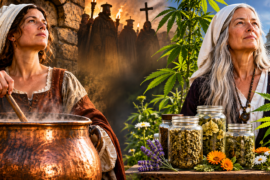
There is another troubling aspect to this situation as we recognize a repeating pattern of capitalism. For centuries, women worked independently as brewers, healers, midwives, textile producers, and merchants.
As capitalism developed, economic systems increasingly depended on labor that was either unpaid or grossly undercompensated. Enslaved people were forced to produce wealth for others. Women’s labor, meanwhile, was increasingly confined to the household and redefined as a natural obligation rather than economically valuable work.
Work women had once performed for compensation became something they were simply expected to do because they were women. Their healing, their cooking, their textile production, their care for children and the elderly—all could be dismissed as expressions of women’s supposed nature rather than recognized as labor.
And when these same activities became profitable industries, men and institutions increasingly controlled the businesses and collected the money. Capitalism did not merely reorganize production. It benefited enormously from the exploitation of enslaved labor and the unpaid labor of women.
We founded Sisters of the Valley because we wanted to live a pre-Christian, Beguine-like lifestyle without disconnecting from the community around us. We wanted to earn our own support and pay our taxes through work that helped reduce suffering.
We weren’t asking anyone to support us. We were supporting ourselves. We built our business around traditional practices, including working with the cycles of the moon. We developed our formulas, learned our trade, and built relationships with customers around the world.
And I have to tell you, I’m tired. I’m tired of defending the right of women to work with plants, make something useful, earn a living, and care for their communities. I’m tired of watching independent producers struggle against regulations that only large corporations have the resources to navigate. And I’m tired of seeing people who depend on our products treated as though their experiences don’t matter – their pain doesn’t matter.
There is a long history of women being pushed aside when their independent work becomes something more powerful interests want to control. We explore that history in greater depth in our companion article, From Alewives to Hemp Sisters: The Displacement of Women from Their Industries. But the question facing us today is immediate.

Follow the Money
Why is this happening again, and why is it happening now? To answer that, we need to follow the money. Look at the political contributions. Look at the industries competing for the same consumers. Look at who has the financial resources to influence legislation and who does not.
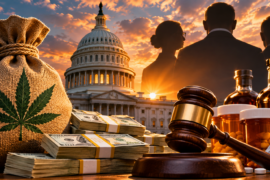
In June 2026 alone, six major cannabis entities contributed $11.5 million to America First Agriculture Action, a political action committee connected through its treasurer to Trump’s political operation. Four companies or affiliated entities contributed $2.5 million apiece. Two additional contributors supplied another $1.5 million. And that is only part of the political spending associated with major cannabis interests.
Meanwhile, there are hundreds of small businesses operating in this space, employing thousands of people that must stop doing what we’ve always done before. But it’s looking like those six are going to get their way.
The alcohol industry has a stake in this, as well. Their sales go down year over year and they attribute that to the availability of a better alternative – cannabis. The pharmaceutical industry also has an economic interest in how people manage pain and sleep.
And major cannabis corporations have a financial interest in the regulatory structure governing competing hemp products. So we want to know:
Who pushed for these restrictions?
Who helped write the language?
Who contributed money to the politicians and political organizations involved?
Who stands to benefit when thousands of small producers can no longer sell their existing products?
And will the largest corporations eventually receive regulatory advantages that smaller producers cannot obtain?
These are questions worth investigating.
We’ve devoted a separate article, Follow the Money: Who Is Behind the Federal Hemp Ban?, to examining the political contributions, lobbying, and economic interests surrounding this legislation.
For now, one thing is clear. The economic consequences of these restrictions will not be distributed equally. Large corporations have resources that independent producers simply do not possess. And the people who depend on these products have no lobbying organization with the financial power of the alcohol industry or the pharmaceutical industry.
The people who will suffer most are the people with the least influence over the decision.
Congress Still Has Time
December 11 is approaching quickly. But Congress still has time to address the situation.
On November 17, Senators Amy Klobuchar and Tim Sheehy introduced bipartisan legislation proposing a regulatory framework for hemp-derived cannabinoid products as an alternative to the impending federal restrictions. Other lawmakers have also been discussing proposals to delay or revise the law.
The December 11 deadline coincides with federal funding negotiations, giving Congress another opportunity to act. There is still time. And there is still time for Americans to make their voices heard.
Our Message to Congress: It’s Not Too Late. Stop the Theft of an Entire Industry!
It only takes a few minutes. Search for your congressional representative and your United States senators, enter your ZIP code, and find their official contact information. Call their offices. Send them a message. Tell them that this law is anti-small business, anti-woman, anti-family, and anti-American.
You don’t need to be a lobbyist. You don’t need a political action committee. You don’t need to spend anything. You have a voice, and the people serving in Congress are supposed to represent you. That’s their job!
And to Congress, our message is this: Stop the theft of an entire industry. Stop stripping livelihoods from the people who built them. Stop making life harder for people who are already suffering. The deadline is December 11. It’s not too late. Do something now.
Read More on This Subject
Follow the Money: Who Is Behind the Federal Hemp Ban?
An investigation into the political contributions, lobbying interests, and economic relationships surrounding the December 11 restrictions.
From 1400 to 2026: The Theft of the Brewing Industry to the Theft of the Hemp Industry
How women’s independent work was appropriated, commercialized, or transformed into unpaid labor—and why women are still fighting for economic independence.



Comments are closed.