



In the first article in this series, we examined how the Employee Retention Tax Credit grew from an emergency employment incentive into one of the largest and most troubled pandemic-era tax programs in American history.
In the second, we stepped inside the machinery and told our own story: how Sisters of the Valley hired specialists, worked through its professional payroll company, filed a claim for approximately $55,000—and are still trying to collect it.
But there is a larger question. Did the ERTC actually work?
The federal government ultimately provided approximately $283 billion in Employee Retention Credits. Nearly five million claims had been processed by June 2025. That’s an extraordinary public investment. And unlike some sprawling government programs whose objectives can be difficult to define, the purpose of this one was right there in its name.
Retain employees. So what did taxpayers buy for $283 billion?

Sometimes, Exactly What Congress Intended
There is no question that the ERTC helped real employers. The National Council of Nonprofits documented the experience of a small human-services organization in Washington, D.C. that used the credit to keep 11 full-time employees and several part-time employees working through the pandemic. It qualified for approximately $85,000 for 2020 and another $115,000 for the first three quarters of 2021.
Another nonprofit serving children in the Pacific Northwest received approximately $230,000 through the program. It didn’t merely retain employees. It added four staff positions to respond to increased demand for its services.
A faith-based community center in Pennsylvania received approximately $100,000 for 2020 and more than $250,000 for 2021. And organizations representing construction companies, senior-living providers, nonprofit theaters and YMCAs publicly described the ERTC as an important tool for preserving jobs and services during the pandemic.
Those aren’t abstract economic models. Those are people who continued receiving paychecks and organizations that continued providing services. For those employers, the program did something very close to what Congress intended.
But How Many Jobs Did $283 Billion Actually Save?
This is where the answer becomes surprisingly difficult. It is tempting to take the number of workers whose wages were used to calculate ERTC claims and call those “jobs saved.”
But that isn’t what the number means.
An employer could qualify for the credit because it retained an employee during a qualifying period. That does not necessarily prove the employee would otherwise have been laid off. Economists call this the counterfactual problem.
To determine how many jobs the ERTC actually saved, we would need to know what each employer would have done if the credit had never existed.
Would the employee have been retained anyway?
Would hours have been reduced?
Would the business have borrowed money?
Would the worker have been laid off?
Would the company itself have failed?
Those alternate histories don’t appear on a Form 941-X. So while we can identify businesses and organizations that say the credit helped them retain workers, we should be careful about turning the number of credited employees into a national “jobs saved” figure.
After spending $283 billion, America still doesn’t appear to have a clean answer to the most obvious question: How many jobs did the Employee Retention Tax Credit actually retain?

Then We Found the Problem
The Government Accountability Office found something that changes the way the entire program should be evaluated. Most of the money arrived after the emergency employment period was over.
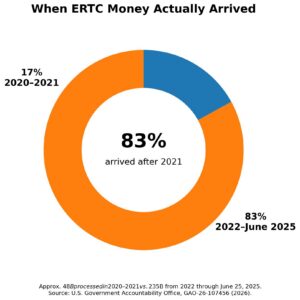
The ERTC applied primarily to qualified wages paid in 2020 and 2021. Yet GAO found that approximately 83% of ERTC refund dollars—about $235 billion—were issued from 2022 through June 2025.
Only about 17% was distributed during 2020 and 2021. By the time most of the ERTC money was being distributed, unemployment had already returned to roughly its pre-pandemic level.
That doesn’t make the later payments worthless. A business that survived COVID might use a delayed refund to replenish inventory, repay debt, repair its balance sheet, raise wages, hire people or simply recover from the enormous financial damage of the pandemic. But it does change the economic question.
A tax credit received after an employee has already been retained cannot have caused the original decision to retain that employee. It can reward that decision. It can repair some of the damage caused by making it. It can help the business survive afterward. But it cannot travel backward in time.
The comparison with the Paycheck Protection Program is illuminating. Both programs were intended, in different ways, to help employers maintain payroll during the pandemic.
But they delivered money very differently.
According to GAO, PPP had distributed almost $800 billion by the time the program ended in June 2021. Approved PPP loans generally were supposed to be disbursed within ten calendar days. ERTC ultimately provided approximately $283 billion—but only about 17% of those refund dollars were distributed during 2020 and 2021.
PPP largely put money into businesses during the emergency. ERTC increasingly compensated businesses after the emergency. Those are not economically identical forms of relief. And Sisters of the Valley experienced both. Our PPP money arrived when we were making pandemic-era payroll decisions. Our ERTC did not. We are still waiting.
The Program Changed Character
This may be the most important lesson of the ERTC. The original concept was remarkably practical: if the government could reduce the cost of keeping employees on payroll during an economic catastrophe, perhaps employers would lay off fewer people.
And employers could originally obtain the benefit in ways connected much more closely to current payroll—including by reducing certain employment-tax deposits and, in some circumstances, requesting advances.
But as the program evolved, amended returns became an enormous part of the system.
By June 2025, GAO reported that approximately 82% of the dollars in processed ERTC claims had been filed through amended employment-tax returns, principally Form 941-X.
The program had gradually become something different. For many businesses, it was no longer: Here is money that may help you retain this employee. It became: You retained this employee several years ago. Here is money you qualified for because you did.
Those can both be worthwhile public policies. But they are not the same public policy.
Then Fraud Changed the Experience for Everyone
The enormous retroactive market created another problem. Businesses learned they could amend old payroll returns and potentially obtain very large refunds. An aggressive ERTC-promotion industry followed. Eligibility rules were oversimplified. Employers were told they qualified when they didn’t. Promoters charged large contingency fees.
The IRS eventually concluded that the volume of questionable claims required extraordinary intervention.
In September 2023, it imposed a moratorium on processing newly filed claims and substantially slowed other processing while it attempted to separate legitimate claims from improper ones. The National Taxpayer Advocate later described the resulting situation bluntly: delaying claims protected public money from improper payments, but also harmed legitimate businesses waiting for funds Congress intended them to receive.
By October 2024, approximately 1.2 million claims remained in the backlog, many already more than a year old. The government had created an incentive. Then an industry grew around claiming it. Then fraud concerns overwhelmed the system administering it.
Then legitimate employers paid part of the price for the fraud committed by others.

There Is Some Good News
The backlog is finally approaching its end. As of the week ending August 29, 2026, the IRS reported approximately 14,900 ERTC claims remaining in various stages—including claims under review, awaiting payment or disallowance, under audit, awaiting review of responses to disallowances, and in Appeals.
That is a remarkable reduction from the 1.4 million-claim backlog reported in 2024.
It also means something rather strange for Sisters of the Valley. After nearly five million claims have passed through the system, we appear to be among a relatively small population still waiting for final resolution. The IRS says it expects to complete the initial review of substantially all remaining ERTC claims by the end of 2026. We would very much like to be one of them.
So, Did It Work?
Yes. And no. And that’s not a dodge. The ERTC demonstrably put money into organizations that used it to retain employees, maintain operations and, in some cases, expand employment during extraordinary circumstances.
It also delivered the overwhelming majority of its dollars after the qualifying employment period had ended. It became vulnerable to aggressive promotion and improper claims. Its administration eventually produced a backlog measured in more than a million claims. And years after the pandemic ended, legitimate employers were still waiting for money associated with employees they had retained long ago.
The mistake would be to force all of that into a verdict of success or failure. The more useful conclusion is that the ERTC became several programs over its lifetime. It was an emergency payroll incentive. It became a retroactive business-recovery payment. It became an extraordinarily lucrative market for ERTC promoters. It became an enormous IRS compliance problem. And for a small group of employers still waiting in 2026, it became something else entirely: a promise.
Emergency Relief Has a Clock
There is a lesson here that extends well beyond COVID. Governments will face another economic emergency. There will be another earthquake, financial crisis, pandemic, terrorist attack, hurricane, wildfire or event nobody has anticipated yet. Congress will again have to decide how to keep businesses alive and workers employed.
When that happens, the lesson of the Employee Retention Tax Credit should not simply be don’t do this again. Parts of it worked. The better lesson is more demanding: Design emergency relief so legitimate recipients can actually receive it during the emergency.
Build fraud controls at the beginning rather than after an industry has formed around exploiting the program.
Give small employers a way to determine where their claims stand.
Recognize that professional intermediaries can simplify compliance while also leaving employers dependent upon systems they cannot see or control.
And distinguish between an incentive intended to change today’s behavior and a reimbursement delivered years after the behavior has already occurred.
Because emergency relief has a half-life. Its value doesn’t necessarily disappear when it arrives late. But its purpose can. Sisters of the Valley retained its employees during COVID. We qualified for a credit Congress created for businesses that did exactly that.
Four years after beginning the process, we are still waiting. The ERTC may yet help our business. It just can’t retain the employees we already lost while waiting for it. And Vensure is still ignoring our requests for them to act.








Comments are closed.