


By Sister Kate, Founder of Sisters of the Valley
November 2026
In June 2026, six cannabis-industry entities contributed $11.5 million to a political action committee aligned with Donald Trump. Four contributed $2.5 million each, while two others contributed a combined $1.5 million. Meanwhile, thousands of small hemp businesses across America are facing a federal law that threatens to eliminate the products they have spent years developing, manufacturing, and selling.
On December 11, 2026, new federal restrictions are scheduled to take effect, limiting finished hemp-derived cannabinoid products to 0.4 milligrams of total THC and certain related cannabinoids per container. For Sisters of the Valley, that means our half-ounce tin of topical salve, containing approximately 7 milligrams of THC, would exceed the federal limit more than seventeen times. It should be noted that we follow the established U.S. hemp threshold in ensuring that the percentage of THC remains under .3%.
We have made and sold that salve for more than a decade, and now our government is preparing to make it unlawful.
So we have some questions. Who wanted these restrictions? Who helped write them? Who spent money influencing the people who passed them? And who stands to inherit the customers and revenues of the small businesses that disappear?
Follow the money.
Eleven and a Half Million Dollars
The political contributions are documented. According to Federal Election Commission records, six cannabis-industry companies and affiliated entities contributed $11.5 million to America First Agriculture Action, a Trump-linked super PAC, in June of 2026.
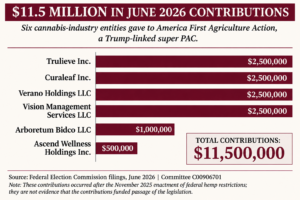
The contributors were Trulieve, Curaleaf, Verano, Vision Management Services, Arboretum Bidco, and Ascend Wellness. The first four contributed $2.5 million apiece. Arboretum Bidco contributed $1 million and Ascend Wellness contributed $500,000.
These contributions were made to a political action committee, not directly to Trump’s presidential campaign. That distinction matters legally, but it doesn’t change the amount of money involved. The Federal Election Commission reports that America First Agriculture Action raised $13.75 million through October 14, 2026. The committee spent nearly $12 million during that period, including more than $4 million in independent expenditures. That is a substantial political operation, funded overwhelmingly by interests associated with the cannabis industry.
What were those interests hoping to accomplish? We know that major cannabis companies have sought changes in federal banking laws, cannabis scheduling, and tax treatment. Those are well-documented industry priorities. But we also know that the regulated cannabis industry competes with businesses selling hemp-derived products outside state dispensary systems. That creates a potential economic conflict.
If independent hemp products disappear from the market, some consumers may turn to dispensary products instead. The question is whether any of the companies funding political activity also supported restrictions that would produce that result. We intend to examine that question.
Three Industries With Something at Stake
The cannabis industry is not the only industry with an economic interest in hemp regulation. Consider the pharmaceutical industry. Millions of Americans use medications for pain, sleep, and anxiety. Some consumers also use CBD products for those same purposes.
At Sisters of the Valley, we have spent nearly twelve years listening to customers tell us why they purchase our products. Some say our salves help them manage pain. Some report sleeping better. Some say they have reduced their reliance on pharmaceutical products. These are customer experiences, not clinical trials, but customers making different purchasing decisions can affect markets.
The alcohol industry also has an interest in how cannabis availability influences consumer behavior. Researchers have studied whether cannabis substitutes for alcohol in some circumstances, although the findings vary across populations and markets. Our own customers have told us they have changed their drinking habits after incorporating cannabis or hemp products into their lives.
We are not claiming that CBD alone explains changes in pharmaceutical or alcohol sales. We are asking why industries with enormous financial and political resources would have no interest in products that some consumers regard as alternatives. And we are asking whether those interests have played a role in shaping hemp legislation.
The third industry is regulated cannabis itself. Large cannabis corporations have invested heavily in licensed cultivation, processing, distribution, and retail operations. Their businesses operate within expensive state regulatory systems, while independent hemp producers often operate under different rules. That difference creates competition, and when government eliminates one category of competitors, it changes the economics of the entire market.
Major alcohol companies lobbied against delaying the restrictions
On October 29, 2026, Politico reported on emails obtained through public-records requests showing that lobbyists connected to three major alcohol companies encouraged state attorneys general to pressure Congress.
The companies were Anheuser-Busch, Molson Coors, and Diageo. The lobbying effort encouraged attorneys general to oppose delaying the restrictions scheduled for December 11. In August 2026, 35 state and territorial attorneys general signed a letter urging Congress not to weaken or postpone the new federal hemp restrictions.
The emails show alcohol-industry lobbyists encouraging that political pressure. They do not establish that the companies wrote the legislation, but they document efforts to preserve its implementation. That’s a significant finding.
Alcohol distributors are lobbying to control hemp-beverage distribution
There’s another development. Federal lobbying disclosures identify activity by the National Beer Wholesalers Association concerning legislation that would bring hemp-derived THC beverages into an alcohol-style distribution system. Under that proposed structure, manufacturers would generally have to sell through wholesalers rather than directly to retailers.
Meanwhile, Total Wine & More reported $510,000 in federal lobbying expenditures during the first nine months of 2026, with regulation of low-dose hemp beverages listed as its lobbying issue. These efforts concern regulation and distribution rather than support for an outright ban. But they demonstrate that established alcohol businesses are working to influence who can participate in the emerging hemp-beverage market.
California: We Have Seen This Movie Before
Sisters of the Valley began manufacturing plant-based wellness products in California in 2015. At that time, California had no dedicated state licensing program available to us for manufacturing the hemp products we were making. For seven years, from 2015 through 2021, we operated without a California hemp-manufacturing license because the state had not established the program. We developed our formulas, built our customer base, paid our taxes, and supported ourselves through our work.
Then California created a licensing system. In July 2022, the California Department of Public Health began accepting applications under its Industrial Hemp Enrollment and Oversight program. The state directed manufacturers toward three existing product categories: human food, pet food, and cosmetics.
We didn’t believe our products belonged in any of those categories. We were making plant-based wellness products, not operating a conventional food business or manufacturing ordinary cosmetics. (Our pet oil came later, and briefly, as the sales didn’t justify the license fees.) Regardless, we didn’t consider our oil drops for pets to be pet food, either. I asked our attorneys which license we should apply for. Human food? Cosmetics? What exactly were we supposed to be?
Their advice was to ignore the new licensing requirements. We followed that advice and operated through 2022 without a license, although the state had begun accepting applications. In retrospect, we should have been licensed that year.
In 2023, we obtained licenses in all three categories: human food, pet food, and cosmetics. We paid the fees, followed the requirements, and continued manufacturing the products our customers had been purchasing for years. We were now operating under the state’s licensing framework. And then California changed the rules.
California’s Emergency Regulations
In September 2024, California adopted emergency regulations restricting hemp-derived foods, beverages, and dietary supplements containing detectable THC. The state said the restrictions were necessary to protect children and teenagers from intoxicating hemp products. Protecting children from intoxicating products is a legitimate public-health objective, but California already had laws governing cannabis, age restrictions, product testing, and labeling. There was no need for another law to eliminate ‘hot cbd’ vape pens being sold to kids. They just needed to enforce the laws on the books. Instead, they chose emergency regulations that effectively wiped out the market for many California businesses manufacturing full-spectrum CBD products.
The emergency regulations made full-spectrum hemp products impossible to sell legally in California. Our cosmetics license renewal was blocked in 2024, and our human-food renewal was blocked in 2025. By 2026, we were without the original licenses we had obtained in 2023.
The products hadn’t suddenly become different products. The regulations had changed.
Unbeknownst to us until just recently, California’s revised hemp law included an exception allowing qualifying topical cosmetics to contain up to 0.3% total THC by dry weight. After the emergency ruling, the California Department of Public Health (CDPH) essentially made a carve-out in their .4 mg per container law – a carve out to allow topical salves to remain at .3% THC by weight.
As soon as we learned about it, we sent in a renewal for our cosmetics license, but the state had already cost us years of business disruption. We had lost sales, customers, and time. We had spent money on licensing, testing, legal advice, and attempts to comply with requirements that kept changing.
California created a licensing system. We obtained the licenses. Then the state changed the rules, and we lost the ability to renew them.
What kind of regulatory system is that?
The Licensing History Tells the Story
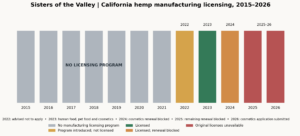
The history of our California licenses illustrates the problem better than any political speech. From 2015 through 2021, there was no applicable California hemp-manufacturing licensing program available to us. In 2022, the state began accepting applications. We sought legal advice and remained unlicensed. In 2023, we obtained all three licenses. In 2024, the emergency regulations disrupted our operations, and our cosmetics renewal was blocked. In 2025, we were unable to renew our remaining licenses. In 2026, we were attempting to obtain a new cosmetics authorization under California’s revised framework.
This is not a business refusing to participate in regulation. This is a business trying to find its place in a regulatory system that did not even recognize the kind of products it manufactured. We believe there should be a licensing category appropriate to plant-based wellness products. Instead, we have spent years being forced into categories that don’t accurately describe our business, and every time the rules change, we bear the cost.
METRC: The Private Business Inside the Regulatory System
California has another regulatory structure that deserves examination. Licensed cannabis businesses must participate in the state’s track-and-trace system, which uses METRC, a privately operated technology platform. METRC tracks cannabis products through the regulated supply chain, from cultivation through distribution and retail.
The state requires participation in this system for licensed cannabis businesses, and participation costs money. Businesses pay for tracking tags and incur the operational expenses associated with compliance. Those expenses are ultimately reflected in the price of regulated cannabis products.
METRC is a private company providing services under government contracts. That arrangement raises important questions about the intersection of public regulation and private profit. When the government requires participation in a particular commercial system, the provider receives a market created by regulation. And when the cost of compliance becomes too high for smaller businesses, those businesses face a competitive disadvantage.
For Sisters of the Valley, there is another problem. Our hemp plants were not grown within California’s licensed cannabis track-and-trace system. That means we cannot simply move our existing products into licensed cannabis dispensaries. We would have to enter a different supply chain, subject to different licensing and compliance requirements.
So when regulators restrict hemp products outside dispensaries, the suggestion that customers can simply purchase those products through the regulated cannabis system overlooks the barriers facing the producers. The consumer may be able to enter a dispensary, but the independent hemp producer cannot necessarily follow.
Who benefits when government creates a marketplace that some businesses can afford to enter and others cannot?
The Cost of Compliance Is Not Equal
Large corporations have compliance departments. They have attorneys, accountants, regulatory specialists, and lobbyists. They can spread those expenses across large operations, while a small producer cannot.
For a business like ours, every new licensing requirement, testing expense, banking restriction, or regulatory change comes directly out of the money available to keep the business operating. And when the rules change suddenly, we cannot simply move production to another state or hire another team of lawyers. We have to absorb the consequences.
California’s regulated cannabis industry provides a disturbing example of what happens when smaller operators struggle to survive in an increasingly expensive marketplace. State licensing records show that California had approximately 9,566 active cannabis cultivation licenses in 2022. By January 2026, that number had fallen to approximately 4,328, a decline of nearly 55%.
California’s own Department of Cannabis Control acknowledges that the industry is consolidating. What it doesn’t acknowledge, in our opinion, is the state’s own role in accelerating that consolidation. Although the number of licenses is not the same as the number of independent businesses, the trend is unmistakable. California’s cannabis industry is contracting, and operators with sufficient capital to absorb the costs of these changes are better positioned to survive.
The state promised an opportunity for independent entrepreneurs when it legalized cannabis. Increasingly, the question is how many independent entrepreneurs will be left. That is why regulatory systems can have effects far beyond their stated public-health objectives. They can determine who is financially capable of remaining in business, and when the surviving businesses are the largest ones, the result is consolidation.
The Platforms Are Closing the Doors, Too
The government doesn’t have to issue a closure order to make a small business disappear. Sometimes it only has to create a regulatory environment that makes private companies unwilling to serve that business.
We experience it first hand with social media shadow-banning and we experience it first hand with banking. For years, Square provided our banking services and they were fair. With the regulatory changes approaching, they’ve already notified CBD businesses like ours that their banking services are being terminated. So we had to transition to a ‘high risk’ bank.
Our replacement bank specializes in cannabis-related businesses and imposes requirements that ordinary businesses often don’t face. Deposited checks are held for fourteen days. There are minimum-balance requirements, restrictions on debit-card use, and monthly fees. These are real challenges, with real costs.
And the problem extends beyond banking. A business needs an online store, payment processing, shipping services, and access to customers. When private platforms withdraw those services because of perceived regulatory risk, they can accomplish what lawmakers have not explicitly ordered. They can make it impossible for a legitimate business to function.
Our products did not suddenly become more dangerous. Our customers did not suddenly stop wanting them. But the commercial infrastructure supporting our business is being withdrawn, piece by piece.
Who Gets the Customers When We Disappear?
This is the question that connects the federal restrictions, California’s licensing history, METRC, and the political contributions. When small hemp producers can no longer manufacture or sell their existing products, their customers don’t simply vanish.
Some customers will make their own products. Some will turn to unregulated sellers. Some will purchase substitutes from larger companies. And some will move into the licensed dispensary market.
The companies best positioned to capture that business are the companies with established distribution networks, substantial capital, and the resources to comply with complicated regulatory systems. That is the economic consequence of eliminating smaller competitors.
It is not necessary to prove that every large cannabis corporation wanted this exact legislation to recognize that some large corporations may benefit from the result. But the political contributions make the question of influence impossible to ignore.
Six cannabis-industry entities contributed $11.5 million to a Trump-linked political action committee in one month. At the same time, thousands of independent hemp businesses were warned that new restrictions are coming. Those are two documented developments. The question is whether there is a connection between them, and that is a question Congress, journalists, and the public should be asking.
Who Wrote the Rules?
We want to know who proposed the federal 0.4-milligram limit. Why that number? What scientific evidence supports applying it to a half-ounce tin of topical salve? Which companies and trade associations lobbied for the restrictions? Which lawmakers received support from organizations funded by those companies? What positions did those companies take on the competing hemp industry? And did anyone evaluate how many small businesses would be forced to close?
In California, we want to know why the state created a licensing framework for hemp manufacturers in 2022 and then imposed emergency restrictions in 2024 that disrupted businesses operating under that framework. We want to know who participated in developing those regulations, which industry groups supported them, and whether anyone calculated the economic losses that would be imposed on small producers. We also want to understand the economics of the METRC mandatory private compliance system.
These are legitimate subjects for public investigation. They deserve answers from the people and institutions responsible for shaping the rules.
Follow the Money. Then Follow the Consequences.
For nearly twelve years, Sisters of the Valley has manufactured plant-based products, supported itself through honest labor, paid taxes, and served customers around the world. We operated before California created a hemp-manufacturing licensing program. We sought legal advice when that program was introduced. We obtained licenses when we understood how the state expected us to operate, and we complied with testing and labeling requirements.
For the past five years, it’s been one legislative pivot after another. And now the federal government is preparing to impose a restriction that takes out an entire industry.
Meanwhile, major cannabis interests are spending millions of dollars on political influence. The companies making those contributions may say they simply want sensible regulation. So do we.
But sensible regulation should protect consumers without destroying legitimate businesses. It should not force independent producers out of the marketplace while leaving only the largest corporations with the resources to survive. And it should not turn government compliance into a system that rewards financial power rather than responsible business practices.
When regulations eliminate small competitors, the public has a right to know who wrote the rules, who paid to influence them, and who stands to profit.
We intend to keep asking. Because when you follow the money, you also have to acknowledge the businesses, livelihoods, and communities left behind.
Read More on This Subject
An Urgent Message to Congress: Do Something Now!
The Sisters have a message for congress, warning them that the only thing this change is doing is increasing the suffering on the planet and making a few of Trump’s friends wealthy.
From 1400 to 2026: The Theft of the Brewing Industry to the Theft of the Hemp Industry
How women’s independent work was appropriated, commercialized, or transformed into unpaid labor—and why women are still fighting for economic independence.





Comments are closed.