


In short
Matriarchal religions are spiritual traditions that center a goddess, or many goddesses, and the principles often tied to the sacred feminine: cooperation, nurture, balance, and reverence for the Earth. They are nearly absent from today’s recognized institutions, and we believe that absence is no accident. As more people feel the weight of what some call the dark night of the soul, many are reaching back toward these older, life-affirming ways. This is the path our sisterhood walks, and below we share why it matters now.
The world feels like it is in a state of upheaval. Climate disasters grow in frequency and ferocity, economic systems strain under their own weight, and political instability threatens the cohesion of societies everywhere. This moment in history feels heavy, laden with uncertainty, as if humanity is collectively living through what mystics have long called the dark night of the soul: a profound spiritual crisis that challenges our core beliefs and calls for transformation. It is a time of reckoning, where old paradigms crumble and the seeds of new ways of being are sown. For us, that is exactly where the conversation about matriarchal religions begins.
Historically, periods of crisis like this one have often come right before profound cultural and spiritual shifts. When the Roman Empire fell, new religious movements rose in its place. After the Great Depression and the World Wars, societies redefined their priorities and gave birth to new social contracts. Now, facing a tangle of existential challenges, we are again at a crossroads, questioning the systems and beliefs that brought us to this brink.
What we mean by matriarchal religions
Before we go further, it helps to be plain about the term. A matriarchal religion is one that places a goddess, or many goddesses, at the center of worship and spiritual authority. The idea has a real scholarly history. Thinkers from the nineteenth century onward, and later researchers associated with the study of Old European cultures, proposed that some early societies may have organized their spiritual life around female deities and traced lineage through the mother. In the twentieth century, a broader Goddess movement grew out of that work and out of second-wave feminism. Scholars still debate how literally matriarchal those ancient societies were, and we are not here to overclaim the archaeology. What draws us is the set of values these traditions point toward.
Those values are simple and old: community over competition, care for the land, and a sense that all living things are connected. You do not need to settle every historical question to feel the pull of that. In a time when so much feels broken, a spirituality built on nurture and balance speaks to a real hunger.
It is worth being honest about the scholarship, since that honesty is part of how we do things. Researchers disagree about how widespread goddess-centered or mother-centered societies actually were in prehistory. Some of the early theories were later questioned, and serious historians caution against painting a simple picture of a lost golden age of women ruling the world. We do not need that myth to be literally true. The historical record does show, clearly and without dispute, that the feminine divine has been honored across countless cultures, and that women have built lasting spiritual communities even under enormous pressure. The medieval Beguines are one of the best-documented examples, and reputable encyclopedias and historians have preserved their story in detail. You can read a careful account of who they were through Britannica’s entry on the Beguines, which describes communities of laywomen who supported themselves and lived a religious life outside the church hierarchy.
Imagining a different future
In post-apocalyptic literature and speculative fiction, one theme keeps offering a glimmer of hope: the return of matriarchal societies and goddess-centered spirituality. From Sheri S. Tepper’s The Gate to Women’s Country to Naomi Alderman’s The Power, these stories imagine futures where humanity turns away from rigid hierarchy and finds renewal in feminine principles of cooperation, nurture, and balance.
These stories land because they tap an ancient wellspring. They picture societies where the divine feminine is not only revered but woven into governance, spirituality, and daily life. The common thread is a return to values that prioritize community, sustainability, and the interconnectedness of all living things, the very values matriarchal systems and goddess worship have long embodied.
This is not a new idea so much as a reawakening. Long before patriarchal religions dominated the world, ancient societies celebrated the divine feminine. They honored goddesses of fertility, creation, and wisdom, and they recognized the cyclical nature of life and the sacredness of the Earth. In times of crisis, these narratives suggest, our collective consciousness drifts back toward those ancient, life-affirming principles.
| Story | What it imagines |
|---|---|
| The Gate to Women’s Country | A post-war society where women steward knowledge and community apart from cycles of violence |
| The Power | A world reordered when women come into a new strength, upending old hierarchies |
| Goddess-centered speculative fiction broadly | Futures renewed through cooperation, nurture, and reverence for the living Earth |
The systemic resistance to matriarchal religions
Despite their deep historical roots, matriarchal religions are conspicuously absent from modern institutional frameworks. Across North America, South America, and Europe, you will struggle to find government-recognized nonprofit entities explicitly dedicated to matriarchal spirituality. We do not believe that absence is a coincidence. It reflects a broader resistance to empowering women-led spiritual movements.
Consider the timeline. The last waves of witch trials in Europe wound down only a couple of centuries ago. Not long after, the modern framework for tax-exempt charitable and religious organizations began taking shape in the United States, with roots in tax law from the late nineteenth and early twentieth centuries and the structure we know today settling into place by the middle of the twentieth century. The history of that framework is laid out in the IRS account of the tax-exempt sector. In a relatively short span, society moved from condemning women as witches to legally recognizing religious nonprofits. And yet, in all that time, no recognized matriarchal religion emerged to take its place at the table.
We are left to wonder about the history hidden in that silence. Did women in the early years of this framework apply to form such organizations and face rejection? Or did the long shadow of patriarchal domination discourage even the attempt? Somewhere in those decades, was there a woman who dreamed of a matriarchal religious order, her application quietly shelved? Did someone else try again a generation later, only to meet bureaucratic resistance or plain ridicule?
We cannot answer those questions, but the silence in the records speaks volumes. Whether through rejection or omission, the result has been the same: a quiet erasure of matriarchal spiritual frameworks from recognized institutions. Patriarchal systems have long held a near monopoly on religious, political, and economic life, and that monopoly has real consequences. Without easy access to tax-deductible fundraising, matriarchal movements are cut off from the resources they need to grow, which keeps women and their spiritual traditions starved of footing.
Yet the demand for these spaces is undeniable. In an era of disillusionment with traditional institutions, many people are looking for spiritual frameworks that align with equality, compassion, and sustainability. To shut matriarchal religions out is to deny society a chance to explore a path that, for many, offers the most comfort and healing.
A quick map of the terrain
Because these ideas get tangled together, here is a plain table to keep the distinctions clear.
| Term | What it points to |
|---|---|
| Matriarchal religion | A spiritual tradition centering a goddess or goddesses and the values of nurture, balance, and care for the Earth |
| The divine feminine | The sacred feminine principle, honored across many cultures, often as creator, healer, and source of wisdom |
| The Goddess movement | A modern revival of goddess worship that grew through the twentieth century alongside feminist thought |
| The Beguines | Medieval European women who lived and worked communally, held property, and inspired our own sisterhood |
The early vision for our sisterhood
When I first formed the Sisters of the Valley, I had already spent four years at protests as Sister Occupy, deep in conversations about how society might change. Knowing my beliefs, men and women alike encouraged me to start a religion. My answer was always the same: if you line up a thousand random people from any country and ask everyone who thinks the planet needs another religion to raise their hand, not one hand would go up.
What I did not fully grasp at the time was that the religions people were tired of were patriarchal ones. If I had, I might have sharpened the line: we do not need another patriarchal religion. The absence of matriarchal ones is not accidental. They have been pushed to the margins, treated as suspect ever since the era of the witch hunts.
Over time I have come to believe that the staying power of patriarchal religions rests, in no small part, on their feminine icons, because women have always found ways to reach the divine feminine anyway. My mother only ever prayed to the Virgin Mary. She would say, “I take my problems to Mary, and Mary takes them to Jesus. What son would deny his mother’s request?”
As a young girl hearing that for the first time, I thought it sounded a little too political, as if Mary were a personal lobbyist. And as men go, Jesus always struck me as plenty approachable. But I knew better than to argue religion with Mom. As I have grown older, her view has come into clearer focus. I now see Mary’s enduring popularity as something rising from a deep societal need to connect with the feminine divine. Consciously or not, she became a bridge for people seeking the compassion and nurture long associated with the goddess.
“We are not trying to romanticize the past. But there are things in it worth carrying forward, above all the way our ancient mothers worked in harmony with nature, held property of their own, and cared for one another. That is the inheritance we are trying to live.”
the Sisters of the Valley
Our enclave draws its model from the Beguines, those medieval women who lived in clustered communities, ran their own businesses, held private property, and answered to no church hierarchy. Historians note that they were eventually met with prejudice and restrictive decrees even as some communities endured for centuries, a pattern documented in this encyclopedic history of the Beguines. You can read more about who they were in our reflections on being Beguine and on how we break from the custom of nuns while honoring that older lineage.

Ancient ways for new times
Matriarchal religions and goddess-centered spirituality offer real lessons for navigating this moment. I truly believe the way through the dark night of the soul is to reconnect with ancient ways of living and thinking. They remind us of the importance of balance, the sacredness of the natural world, and the interconnectedness of all life.
These principles can guide us toward a more harmonious way of being. They invite us to reconsider our relationship with the Earth, to choose community over competition, and to embrace cycles of renewal and rebirth. Woven into modern life, those timeless values might help heal not only our planet but our fractured spirits.
| Ancient principle | How it might guide us now |
|---|---|
| Balance | Seeking equilibrium rather than endless extraction, in our lives and with the land |
| Sacredness of nature | Treating the Earth as kin to be cared for, not a resource to be spent |
| Interconnectedness | Remembering that the wellbeing of one is bound up with the wellbeing of all |
| Renewal and rebirth | Living by cycles, like the moon, that make room for rest, return, and beginning again |

To make space for matriarchal spirituality is not only to honor history. It is to choose a path forward that prioritizes healing, equity, and a deeper connection to the natural rhythms of life. It answers a call that has echoed for centuries, inviting humanity to reclaim balance and harmony.
The idea of founding a government-recognized matriarchal religion may sound revolutionary. In truth, it is just an attempt to make fair and equal space for a belief system whose heart is a return to the very roots that have sustained humanity for millennia. The future we imagine may already be written in the wisdom of the past, waiting for us to rediscover it.
How this shows up in the work we make
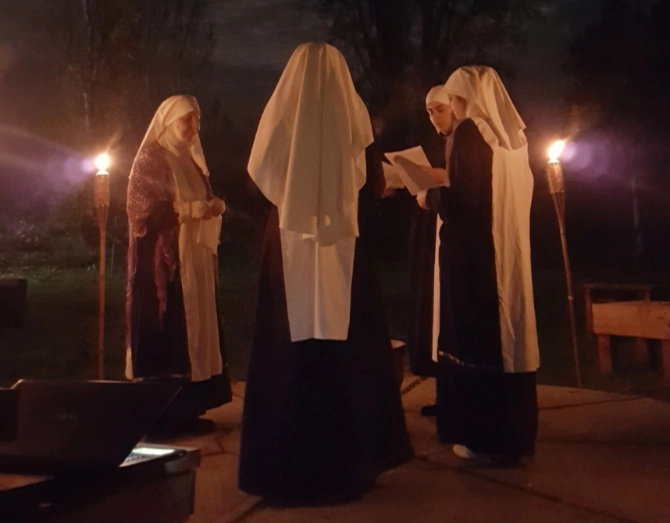
For us this is not abstract. The sacred feminine shapes how we live and how we make our plant medicine. We are a women-led sisterhood in Merced, California, and we organize our days by the moon cycles, grow and formulate our own plants, and set prayer and intention into every batch. The point is not to sell you on a belief. It is that the values in this essay, care, balance, and reverence for the Earth, are the same ones our hands follow when we make a salve or an oil. If that resonates, you are welcome to learn the Sisters’ story or simply see what we make by hand.
Frequently asked questions
What is a matriarchal religion?
It is a spiritual tradition that centers a goddess or goddesses and the values often tied to the sacred feminine: nurture, cooperation, balance, and reverence for the Earth. The term also covers scholarly theories about goddess-centered spirituality in some early societies.
Are matriarchal religions the same as the Goddess movement?
They overlap but are not identical. The Goddess movement is a modern revival of goddess worship that grew through the twentieth century. Matriarchal religion is the broader idea of a faith centered on the feminine divine, which that movement helped bring back into conversation.
Why are there so few recognized matriarchal religions today?
We believe it reflects a long history of resistance to women-led spiritual movements, going back to the era of the witch hunts. Without easy access to the institutional and financial footing other faiths enjoy, these traditions have struggled to take a recognized seat at the table.
What does the “dark night of the soul” mean here?
It is an old phrase for a deep spiritual crisis, a stretch of darkness and doubt that tests your core beliefs. We use it to describe what many people feel right now, both personally and collectively, and we see reconnecting with ancient ways as part of the way through.
Who were the Beguines, and why do they matter to the Sisters?
The Beguines were medieval European women who lived communally, ran businesses, held their own property, and lived a spiritual life outside church hierarchy. We model our sisterhood on them, which you can read about in our posts on being Beguine and the Book of the New Beguines.
Is the Sisters of the Valley a religion?
We are a spiritual, women-led sisterhood that lives by ancient traditions of respect for the Earth, and we make plant-based products by hand. Our spirituality guides how we work, and you can learn the fuller picture on our story page.
Walking the path together
The case for matriarchal religions is not really about adding one more faith to a crowded world. It is about making fair room for the sacred feminine that humanity keeps reaching for, especially in hard times. We live that belief every day in our enclave, and we would be glad to have you walk a little of the path with us.
Walk with the sisterhood
Learn more about who we are and how we live on the Sisters’ story, explore the plant medicine we make by hand, or reach out to us directly. You are also always welcome to visit us in Merced at 3144 G Street.



Comments are closed.