


There is a particular kind of helplessness that comes from doing something the responsible way and discovering that responsibility has left you with fewer options, not more.
Sisters of the Valley did not respond to a “$26,000 per employee” advertisement. We did not hire an anonymous ERTC promoter who cold-called us. We hired specialists to determine whether we qualified for the Employee Retention Tax Credit and calculate our claim. Then we turned their work over to the professional payroll and human-resources company already responsible for our employees and payroll taxes.
There were professionals on both sides of the transaction. There were lawyers. There were calculations. There were reviews. There was, eventually, a filing. What there wasn’t — our money.
More than four years after we began working on the ERTC, Sisters of the Valley is still waiting for an approximately $55,000 tax credit earned for keeping employees working through the pandemic. And somewhere along that journey, the professional payroll company we had hired in part to protect us from payroll-tax problems became the gatekeeper to a problem we could not solve ourselves. And our gatekeeper is not trying to solve the problem either.
We Had Already Learned the Hard Way
To understand why we relied so heavily on Vensure, it helps to understand why we hired them. Before Vensure, we had used a small local accounting firm to handle payroll. But we had already learned how vulnerable a small employer could be when dealing with California’s payroll-tax system. Years after wages had been paid and taxes filed, the state could revisit how particular workers or positions had been classified, make a different determination, and assess additional payroll taxes against the business. Surprise bills kept appearing.
After going through that experience, we decided we didn’t merely need a company that could calculate wages and issue checks. We needed a payroll company with the resources – and the lawyers – to challenge the arbitrary surprise assessments by the state tax authorities.
That was the main reason we went to Vensure. And Vensure was not a neighborhood payroll processor. Today, Vensure Employer Solutions describes itself as the largest privately held organization in the HR technology and services sector, serving more than 161,000 businesses and processing more than $153 billion in payroll annually. The company is backed by private-equity firm Stone Point Capital and has grown through an aggressive acquisition strategy.
In hindsight, that decision is what makes the next four years so frustrating. We weren’t trying to save money by doing payroll ourselves. We weren’t looking for shortcuts. We deliberately put a sophisticated professional organization between our small company and some of the most complicated parts of employing people. Then COVID happened and we learned that one can be punished for using a professional third party for processing payroll.
We Hire ERTC Specialists
By 2022, businesses were being inundated with advertising from companies promising enormous ERTC refunds. We were cautious. On August 26, 2022, Sisters of the Valley retained Clarus Solutions to determine our eligibility for the Employee Retention Tax Credit and prepare the claim.
Clarus did considerably more than plug employee counts into an online calculator. Its package included a written tax memorandum explaining the legal basis for eligibility, detailed quarterly calculations, PPP-loan adjustments and documentation intended for the professional employer organization that would ultimately prepare the amended payroll-tax filings.
The result was precise: $55,523.77.
The calculated credits covered three quarters of 2021:
- First quarter: $20,342.46
- Second quarter: $22,328.95
- Third quarter: $12,852.36
Clarus completed the package and delivered it to Vensure on November 10, 2022. Then we waited for our payroll company.
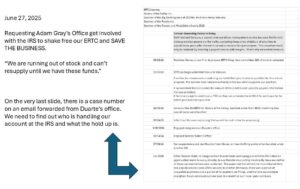
The Sisters’ ERTC journey began in 2022. This timeline was later assembled as part of a congressional request for assistance.
Nearly Three Months to File
Vensure had a necessary role in the process because of the way our payroll taxes had been administered through the professional employer organization, or PEO. Vensure reviewed the package and ultimately filed the claim on February 3, 2023 – nearly three months after receiving the completed work from Clarus.
At that point, we believed the hard part was over. It wasn’t.
Vensure later explained something that would become increasingly important: claims from its clients were not necessarily traveling through the IRS as neat, individual little packages bearing each employer’s name and tax identity. The PEO structure meant multiple client claims could be bundled through Vensure’s tax filings. That made Vensure more than the company that processed our payroll.
For purposes of figuring out what had happened to our ERTC, Vensure was in the middle.
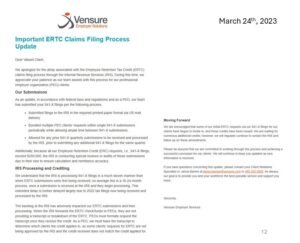
In March 2023, Vensure explained the process and complications surrounding ERTC claims filed through a professional employer organization.
Then We Waited
At first, waiting wasn’t alarming. This was the federal government emerging from a pandemic. Millions of businesses were filing claims. The IRS was overwhelmed. Processing delays were widely reported.
So we waited. Then we asked. Then we asked again. Over time, asking became something of a ritual.
After the first year, we were asking for help roughly monthly. When that produced no resolution, the inquiries became quarterly. Eventually, after years of getting nowhere, they became twice yearly.
Not because the money mattered less. We had simply learned that asking more frequently wasn’t making anything happen.
Clarus – later operating as Arvo Tech – continued to check in as well. In March 2023 it asked whether the refund had arrived and offered to contact the IRS if we executed the authorization necessary for it to make the inquiry.
A year later, in March 2024, the answer was still no. By then, we were contacting our congressman’s office for help.
Too Small for Help
There was another indignity buried in the process. Vensure developed a program to assist customers with their ERTC claims and even pre-finance anticipated refunds. We pursued it. Our claim was too small. The minimum was $75,000. Ours was under that amount.
That distinction may make perfect economic sense from the perspective of a company deciding which transactions justify the cost of intervention or financing. From the perspective of a small business, however, it produced a strange result.
Our claim was large enough to matter enormously to us, but apparently not large enough to qualify for that particular level of help. Fifty-five thousand dollars can be small money to an institution and survival money to a small business at exactly the same time.
Something Was Wrong
By 2024, this no longer felt like an ordinary processing delay. We began trying to determine whether there was an underlying problem with the payroll filings themselves.
In August 2024, we were specifically trying to uncover whether Forms 941 – the quarterly federal payroll-tax returns underlying the amended ERTC filings – were part of the problem. This matters because an amended payroll return does not exist in isolation. The IRS has to be able to match it to the original payroll-tax record. Our records from the time show that we were actively raising the issue and trying to determine what was missing.

At that stage, we knew there was a problem. We did not yet know precisely where responsibility for it rested. But the concern wasn’t imaginary.
The IRS Needed the Original Returns
The Taxpayer Advocate correspondence eventually brought the issue into much sharper focus.
The documents that had been provided were not sufficient. The IRS needed complete copies of the original Forms 941 for the relevant quarters.
And the consequence was not theoretical: without the original returns, the amended Forms 941-X containing the ERTC claims could not be processed.

That is where the PEO relationship became especially consequential. We had hired professionals precisely because we did not administer these filings ourselves. The original payroll-tax records and the amended returns existed within a system managed by the professionals we had entrusted with payroll.
The more complicated the problem became, the less capable we were of fixing it independently. The expertise we had purchased for protection had also created dependency.
Then, Finally, a Human Being Called
In January 2025, after years of waiting, an IRS agent called. According to the chronology we recorded for our later congressional request, the agent told us that our funds were approved and waiting for a discrepancy to be resolved. She had identified problems associated with the transition from our former local payroll provider to Vensure. There had been a period involving unapplied payments and another period in which she found no payments or filings, and she was working to straighten out the account.
That was the first time in years that the fog seemed to lift. There was a problem. Someone inside the IRS had found it. Someone was working on it. She told us she would call again in approximately a month. She never did. DOGE happened that same month and we assumed her entire department was wiped out.
Meanwhile, the World Kept Turning
This is where the bureaucratic chronology becomes a small-business story. It has been more than four years since we began the work that led to this ERTC claim. We are now in our third year of trying to collect it.
Those were not three static years for Sisters of the Valley. We came out of COVID with roughly half the sales we had going into it. Then floods and mudslides struck California. Crops were lost. Costs rose. Sales fell further.
Late in 2024, California changed the rules governing hemp products, dramatically altering the market for full-spectrum CBD businesses. Federal lawmakers followed with another fundamental rewrite of hemp law in 2026. All the while, the approximately $55,000 ERTC remained somewhere inside the system.
By June 2025, we were telling our congressman’s office exactly what that meant in practical terms.
Of the approximately $55,000 refund, about $12,500 was owed to the ERTC lawyers under their contingent-fee arrangement, leaving roughly $42,500 for the business. At the time, we owed approximately $25,000 to a supplier who would not provide additional product until the balance was paid. Products were going out of stock. Sales were declining. We were approaching the point where remaining open was becoming a question rather than an assumption.
The same presentation noted something almost painfully ordinary: Our supplier in Colorado had already received its ERTC refund about a year earlier. The program worked for them. We were still waiting.
The Credit That Was Supposed to Retain Employees
There is an especially bitter circularity to our experience. The Employee Retention Tax Credit existed because Congress wanted employers to keep people working during an unprecedented economic crisis. We did. We kept our employees through COVID. But a program intended to prevent layoffs was delayed so long that businesses were laying people off while waiting for the employee-retention money.
We know because we were one of them. Eventually, Sisters of the Valley could no longer afford employees at all. We earned an Employee Retention Tax Credit for retaining employees, then lost our employees while waiting for the Employee Retention Tax Credit to arrive. That sentence sounds almost absurd. Living it was considerably less amusing.

Asking Congress to Help
Eventually, there wasn’t much left for us to do except keep escalating. We sought congressional assistance. We assembled the history. We supplied the calculations. We documented the correspondence. We explained the missing-return problem. We described the IRS agent’s call. We explained what the money now meant to the survival of the business.
On June 27, 2025, the package was formally submitted through Congressman Adam Gray’s office.
And still we wait.
What Exactly Did We Do Wrong?
That question has followed us through this process. Should we have hired professionals? We did.
Should we have used an established payroll company? We did.
Should specialists have researched our eligibility rather than our attempting to interpret a complicated tax program ourselves? They did.
Should our payroll provider’s legal professionals have reviewed the work before filing? They did.
Should we have asked questions when the money didn’t arrive? We did, repeatedly.
Should we have sought help from the IRS, the Taxpayer Advocate and eventually Congress? We did that too.
This is not an argument that Vensure created the IRS’s enormous ERTC backlog, nor can we say from the records currently available to us that every problem with our claim was caused by Vensure.
It is something more specific.
A small employer entrusted its payroll-tax compliance to professionals. When a complicated tax-credit claim became stuck, the very structure that was supposed to provide expertise and protection left the employer dependent upon those professionals to obtain records, navigate the filings and communicate through a system the employer did not control. No amount of emails or phone calls could get Vensure to follow up on this. And that is what it means to be caught in the middle.
Four Years Is Not Just a Number
There is a tendency in discussions of government backlogs to talk about time as though it were merely an administrative measurement. But for small businesses, time marches on. During four years, employees leave. Markets change. Suppliers tighten credit. Inventory disappears. Interest accumulates. Customers develop new habits. And sometimes the laws governing your entire industry change underneath you.
A tax credit worth $55,000 to a healthy business in 2022 is not economically identical to $55,000 arriving after years of losses, debt, regulatory upheaval and shrinking inventory. Emergency relief has a half-life.
The longer it takes to arrive, the less capable it becomes of accomplishing the purpose for which it was created. Small businesses don’t get to stop the clock while Washington processes the paperwork. Neither, unfortunately, do their employees.
But Did It Work?
Our experience is one ERTC story. It is not the only one. For other small businesses, the credit arrived. Sometimes it arrived quickly enough to do exactly what Congress intended: put cash into the hands of employers trying to keep people working through an extraordinary economic disruption.
That leaves one question bigger than what happened to Sisters of the Valley, bigger than Vensure, and even bigger than the IRS backlog:
Did the Employee Retention Tax Credit actually work?
Congress ultimately committed hundreds of billions of dollars to a program whose purpose was contained in its name: employee retention. Some employers credit it with helping them survive. Others received the money long after the employment decisions it was intended to influence. Still others, like us, are waiting years later.
So in the third and final article in this series, we step outside our own experience and ask what taxpayers received for that enormous investment. Did the ERTC save jobs? Did it save small businesses? And what happens to the effectiveness of emergency relief when the emergency ends years before the relief arrives?







Comments are closed.