


Most religions have a place you are supposed to go. A church. A temple. A mosque. A meetinghouse. A building with a door through which the faithful enter and, eventually, leave. The Sisters of the Valley Ministry is being built differently. In that respect, of course, we are hardly inventing anything. Long before Europeans raised churches across this continent, many Indigenous peoples gathered in circles, prayed and conducted ceremony outdoors, and understood the natural world itself as inseparable from spiritual life. Sacred practice did not require a pulpit separating the person speaking from the people listening, or even a building separating the people praying from the land beneath their feet.
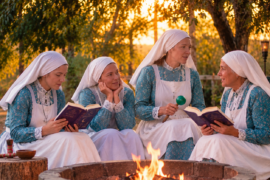
We have always felt a kinship with that understanding—not a claim to Native traditions that are not ours, but a recognition of something they demonstrate beautifully: a spiritual community does not require a church in order to be a spiritual community. The Sisters pray outside. We gather in circles. We mark the cycles of the moon and seasons. We gather around fires, work with the land, share meals and conduct ceremony where the work and the people happen to be.
The Ministry grows naturally from that. We don’t expect people to come to us. We expect the ministry to go where the people are. That distinction has shaped nearly every decision we have made about how this new ministry will grow.

The Ministry Is the People
For more than a decade, people have written to the Sisters asking some version of the same question: How can I be part of this? For many years, there wasn’t a very good answer. You could buy our products. You could follow our work. You could visit the farm under certain circumstances. A very small number of women could pursue the demanding path of actually becoming a Sister.
But none of those things created a meaningful place for the much larger community of people who shared our values without wanting—or being able—to reorganize their lives around ours. The Ministry changes that.
Membership is deliberately simple. A person can read our beliefs and tenets, decide that they resonate, and become a member. No gown is required. No relocation is required. No one has to become a nun. And no one has to surrender the life they already have in order to participate in building something better.
From Membership to Service
Membership, however, is only the beginning. Some people will want to do more. They may become ambassadors, learning the history, beliefs and practices of the Sisters well enough to represent the Ministry in their own communities. Others may feel called toward Sisterhood itself, beginning as applicants, progressing through the novitiate, and eventually—if the calling and the community agree—taking vows. But there is another path that may ultimately matter even more. People can organize.

A Chapter Can Begin Anywhere
A local chapter does not require an abbey. It does not require a priest. It does not require stained glass, pews or a mortgage. It requires people. A handful of people in a town can decide that they want to gather around the principles of service, ecology, spiritual independence and community. They can determine what their own community needs and begin doing useful work there.
One chapter may organize food distribution. Another may tend a community garden. Another may help elderly neighbors with transportation or companionship. Another may gather around environmental restoration, women’s support, education, ceremony, or simply creating a dependable circle of people who show up for one another. The work does not have to look identical from one chapter to another because communities are not identical. The values travel. The work becomes local. Ultimately, though, through the work they do and as we grow, all chapters will be able to participate in the goal of providing affordable housing to the people. There is no place in America that has no need. Or more clearly, all towns and cities across America are suffering a housing affordability crisis.
We Are Not Building Franchises
This distinction matters enormously to us. We aren’t interested in creating miniature copies of the California Sisters scattered around the world. That would defeat the purpose. A chapter in Oregon should eventually look like Oregon. A chapter in Wisconsin should respond to Wisconsin. A chapter in Chile should belong to the people doing the work in Chile.
There should be common beliefs, common standards and a common understanding of what it means to represent the Ministry.
But there must also be autonomy. Matriarchal organization, as we understand it, isn’t about extending authority farther and farther outward from a central throne. It is about distributing authority while maintaining relationship.
There Is Still Structure
Decentralized does not mean disorganized. There are reasons for membership requirements. There are reasons ambassadors are trained. There are reasons becoming a vowed Sister takes considerably more commitment than joining the Ministry. Names, symbols and traditions carry meaning. Anyone representing the Ministry publicly has a responsibility to understand what they are representing. The structure exists to protect the community without controlling it. That balance will undoubtedly require adjustment as we grow. We are building something new from something very old.

The Pulpit Is Wherever the Work Is
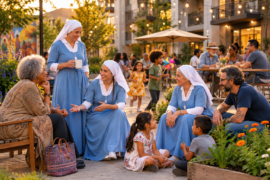
Perhaps the easiest way to understand the Sisters of the Valley Ministry is to stop imagining a church. Imagine instead a network. People gathering in homes, gardens, community centers, farms and borrowed rooms. People sharing meals. People learning from one another. People helping their neighbors. People marking the cycles of nature and the passages of human life. People finding ways to make their own communities slightly kinder, safer, healthier and more connected than they were before. There may someday be physical Ministry houses in many places. We hope there will be. But the buildings are not the Ministry. The Sisters are not the Ministry. Even the organization itself is not the Ministry. The Ministry is what happens when people who share these values begin practicing them together. And for that, no pulpit is required.





Comments are closed.