


For more than a decade, the Sisters of the Valley have lived with an unusual contradiction. We have been highly visible, but not always easily understood. People recognize the gowns. They recognize the activism, the plant medicine, the farm, the moon cycles and the images of women working together. But underneath all of that has always been something harder to photograph: a particular way of organizing life.
The Sisters of the Valley Ministry was created to give that way of life a structure of its own. We call it a matriarchal ministry, but we did not invent matriarchal societies. They are a historical fact.

Matriarchy Is Not Patriarchy in Pumps
Today, when people hear the word matriarchy, they generally imagine patriarchy with the genders reversed: women at the top, men underneath, and women exercising the same kind of domination historically exercised by men. They are wrong. A matriarchy is not a patriarchy in pumps. There is no dominion over a class of people cooked into the formula of a matriarchy. It is actually the opposite.
Historical matriarchal and matrilineal societies included the men in governance. Men participated in important tribal decisions, sitting at the circle with the women, participating in family life, spiritual life and the decisions affecting their communities. What distinguished matriarchal societies is that women possess meaningful social, economic and political authority of their own. Historically, that authority created balance.
In some Indigenous systems, women held particular power over land, property, kinship and leadership. In some, women could select leaders or remove them. Critically for the Sisters, there were traditions in which women held authority capable of restraining decisions concerning warfare and the actions of male leaders that caused any detriment to the tribe.
Men were at the table, but they could not simply remove the women. That is a very different thing from replacing one ruling sex with another. It is also much older than the Sisters of the Valley.
Our own spiritual ancestry reaches particularly toward the Beguines, the communities of medieval European women who created lives together outside the conventional choices available to women of their time. They worked. They prayed. They taught. They cared for the sick and poor. They owned property and supported themselves economically. They lived communally without surrendering themselves entirely to the authority and structure of either marriage or the convent.
They were remarkably independent women for their time. And that independence eventually became dangerous. As religious and political authority became increasingly centralized, communities of spiritually independent women came under suspicion and persecution. The world that allowed the Beguines to flourish narrowed considerably under ecclesiastical scrutiny and the Inquisition.
Centuries later, we are not claiming to recreate their lives. We couldn’t. We live in a different century, on a different continent, confronting different problems. But we recognize the thread. In many ways, we are just picking up where the Inquisition left off. Not by trying to return to the thirteenth century, but by recovering an old idea: women can organize spiritual and communal life without needing to reproduce the hierarchical institutions that displaced those traditions in the first place.
And now that the Sisters of the Valley Ministry exists as a federally recognized nonprofit organization, we get to ask a very practical question: What might that ancient idea of communal living look like now?

Sanctuary Before Empire
When we began planning the Ministry, housing quickly became central to the conversation. Housing insecurity is usually discussed as an economic problem, and certainly it is one. But housing is also connected to loneliness, family instability, health, safety, education and a person’s ability to participate meaningfully in community.
A roof solves one problem. A sanctuary can address several. Our long-term vision is to develop sanctuary-centered housing: places where people have private space but also have access to community, shared resources, gardens, education, meaningful work and the ordinary human relationships that make a collection of buildings into a neighborhood. We are not interested in creating institutions where people are warehoused and managed. We are interested in creating places where people belong. And here the historical model becomes useful again. The purpose isn’t to put women in charge of everybody. It is to restore women to the work of shaping the community itself.
Small Circles
The original vision of the Sisters was never to create one enormous organization controlled from California. The dream was always decentralized.
Women in different communities would develop their own work, suited to their own circumstances, while sharing certain practices, values and responsibilities. The Ministry gives us an opportunity to build that model intentionally.
Local chapters will not need to look identical. A chapter in rural California will inevitably have different needs from one in Chicago, Chile or the Netherlands. One community may concentrate on food security. Another may organize educational programs. Another may focus on elder support, environmental work, housing or community gatherings. What connects them is not a corporate operating manual. It is a shared spiritual culture. The vows and practices provide the roots. The local communities decide how those roots grow in their own soil. And men are not excluded from that work. Neither are families, elders or people who have no interest whatsoever in becoming Sisters. Matriarchal does not mean women alone. It means that women are not subordinate.

A Place for People Who Aren’t Sisters
For years, people have written to us saying some version of the same thing: I believe in what you are doing, but I don’t think I am supposed to become a Sister. We understand. Not everyone wants to live communally. Not everyone wants to wear a veil. Not everyone wants to organize their life around the disciplines practiced by the Sisters. And none of that should be required in order to participate.
The Ministry creates a much wider circle. Someone may simply become a member because the beliefs resonate with them. Others may want to represent the Ministry in their communities. Some women may eventually feel called toward the Sisterhood itself. There should be doors between those circles, not walls. A healthy community needs people at different levels of involvement. It needs the deeply committed and the occasionally available. It needs teachers and gardeners and accountants and musicians and cooks. It needs people who organize events and people who simply show up for them. Community cannot be built entirely by specialists. It is built by participants.
Spirituality That Has Something to Do
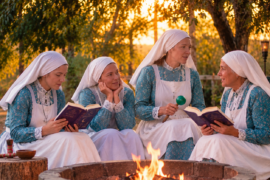
The Sisters have never been particularly interested in spirituality as an abstract exercise. Our rituals developed around work. We pray while making medicine. We mark moon cycles. We bless land and crops. We gather around fire. We share meals. We work in gardens. We observe periods of reflection and gratitude.
The sacred and the practical have never been especially separate around here. That principle carries into the Ministry. Prayer matters. Ceremony matters. Spiritual study matters. But so does making dinner for someone. So does teaching a skill. So does helping an elder who lives alone. So does planting a garden, organizing a neighborhood gathering, sharing resources, or making sure someone has a safe place to sleep. Service is not something that happens after the spiritual work is finished. Service is spiritual work.

The Return of the Village
Modern life has become remarkably efficient at separating people. Children are separated from elders. Work is separated from home. Food is separated from the people who grow it. People can live twenty feet apart for ten years without knowing one another’s names. We have gained convenience while losing many of the informal systems that once helped human beings survive difficult periods. The Sisters cannot reverse all of that. But we can experiment with another direction.
What happens when housing is designed to encourage community instead of anonymity?
What happens when elders remain connected to younger generations?
What happens when people share tools, knowledge, meals, gardens and responsibilities?
What happens when independence does not require isolation?
These aren’t entirely new ideas. That may be the most important point. We aren’t trying to invent the future from scratch. Some of the answers may be waiting in things our ancestors already knew.

Building Slowly on Purpose
The vision for the Ministry is large. The organization, at the moment, is not. That is intentional. We have spent enough years in business to know that organizations can grow faster than their foundations. Money can arrive before governance is ready. Programs can expand before anyone has determined whether they actually work. So we intend to build deliberately. But deliberately does not mean passively.
With our federal tax-exempt status now in place, the work changes. Donations to the Ministry are tax-deductible, and we can begin pursuing the grants and philanthropic funding that can move these ideas from plans on paper to programs in communities—and, ultimately, to buildings. That work has already begun.
Two Sisters are dedicating time to grant research and applications. Sister Hilda has already submitted our first application, seeking a small grant to help fund the decidedly unglamorous things every new movement needs: outreach materials, handouts, prayer cards, community event organization and the tools required simply to let people know we are here.
Small grants can help us build the community. Larger grants, donors and philanthropic partners can help us build the sanctuaries. That is one of the reasons our nonprofit status matters so much to this vision. We do not expect the people who need affordable, community-centered housing to somehow finance the buildings themselves. We believe the Ministry’s nonprofit structure gives us a path toward assembling the grants, charitable contributions and partnerships necessary to acquire property and build the urban sanctuaries envisioned in our plan.
We will still begin carefully. We will learn what works and what doesn’t. We will discover which ideas work beautifully on paper and fail spectacularly when introduced to actual human beings, and we will adjust. We are no longer simply studying whether this can be done. We have begun. And though we are small, so are seeds. And they have been known to sprout some mighty oaks.

An Invitation, Not a Conversion
We are not interested in convincing everyone to believe what we believe, nor are we interested in challenging their beliefs. That would be a peculiar mission for women drawing inspiration from traditions that suffered precisely because powerful institutions insisted that everyone believe and live in approved ways.
The Ministry exists for people who recognize something familiar in these ideas. Perhaps you believe leadership can be collaborative rather than hierarchical. Perhaps you believe caring for the Earth is a spiritual responsibility. Perhaps you believe elders should remain part of community life. Perhaps you believe housing should provide more than shelter.
Perhaps you believe women should possess real authority over the conditions under which women and families live. Perhaps you believe service, ritual, work and spirituality do not need to occupy separate compartments of a person’s life. Or perhaps you simply believe the world could stand to recover some things it discarded along the way.
Good. So do we.
The Sisters of the Valley Ministry is not presenting a finished model to the world. We are building one. And while we aren’t beginning from nothing, some of the ways we hope to carry these old ideas forward are distinctly modern. One of them is something we call the urban sanctuary. Imagine housing designed around the assumption that independence does not have to mean isolation. Private homes, but shared spaces. Gardens. Community kitchens. Places for children and elders. Rooms for learning, gathering, ceremony and service. People living their own independent lives, but with opportunities to know their neighbors, share resources and participate in the care of the community around them. Not a commune. Not an institution. Not housing where someone else has decided how everyone should live, but a beguinage, a village, adapted for the twenty-first century.
We have spent the past year putting numbers, plans and structure around that idea. We have studied what it might cost, how it might operate, how large it should be, and how a first sanctuary could become a model for others. We know we cannot build the whole dream at once. So we intend to build the first one. And if you are wondering who gets to be part of all of this—who can join the Ministry, participate in a local chapter, help build these communities, or perhaps someday feel called to become a Sister—that brings us to the next part of the story.
You don’t have to wear a veil to join us.




Comments are closed.