



Millions of applicants, roughly $242 billion paid, years of delays – and nearly 15,000 claims are still somewhere in the system.
In March 2020, Congress faced a problem nobody had planned for. Businesses were closing. Workers were being sent home. Revenue was disappearing overnight. The federal government needed employers to keep paying people even when, in many cases, there was very little business left for those employees to do.
One answer was the Employee Retention Credit, commonly known to businesses and payroll professionals as the Employee Retention Tax Credit, or ERTC. The idea was remarkably straightforward: if businesses kept employees on the payroll through the economic disruption of COVID-19, the federal government would help shoulder the cost.
What followed was considerably less straightforward. The ERTC eventually became a roughly quarter-trillion-dollar undertaking involving millions of claims, changing eligibility rules, amended payroll-tax returns, aggressive third-party promoters, suspected fraud, processing moratoriums and enormous backlogs.
Six years after Congress created the program, the IRS is still working through its final claims. And somewhere in that remaining pile is ours.

Remember What It Was Like Back Then
Looking backward from 2026, it is easy to reduce the pandemic to dates on a government timeline. That isn’t how small businesses experienced it. At Sisters of the Valley, we entered the pandemic with monthly sales of roughly $100,000. We emerged doing about half that.
We kept people working. We navigated shutdowns, supply-chain problems and constantly changing rules. Like businesses across the country, we learned how to operate through a crisis nobody had included in the business plan.
By the end of 2022, COVID itself was receding. Its economic damage wasn’t. But in California, another disaster was arriving. Atmospheric rivers, flooding and mudslides battered the state during the winter of 2022-23. For an agricultural business like ours, these weren’t television pictures from someplace else. They affected crops, production and, very dramatically, our sales.
Before we had recovered the half of our business COVID had taken, we were heading toward losing half of what remained. It was during this period that our ERTC paperwork was being prepared. That context matters. A small-business owner filing for the ERTC in late 2022 wasn’t necessarily sitting comfortably behind a desk collecting free government money for a pandemic that had ended.
Many were still trying to survive it. And they weren’t tax-credit experts. They had businesses to run. They relied on accountants, payroll processors, HR companies and other professionals to navigate a federal program that had become increasingly complicated.
What Congress actually promised
Technically, the ERTC wasn’t a grant or government award. It was a refundable employment-tax credit created by the CARES Act in March 2020 to help eligible employers retain workers. The IRS itself describes the purpose plainly: the credit was created to help businesses with the cost of keeping employees on staff.
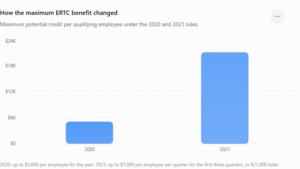
For 2020, qualifying employers could generally claim 50 percent of up to $10,000 in qualified wages per employee – a maximum credit of $5,000 per worker. Congress subsequently expanded the program dramatically. For the applicable periods of 2021, the credit generally became 70 percent of as much as $10,000 in qualified wages per employee, per quarter.
For an employee qualifying throughout the principal periods covered by the program, the combined maximum could reach $26,000. That is where the famous “$26,000 per employee” figure came from. On a government spreadsheet, those are tax credits. To a small business emerging from COVID, that money could mean payroll, suppliers, inventory, rent – or simply surviving another quarter.
Then Congress kept changing it
The ERTC did not remain the program Congress originally passed. It was altered repeatedly by the Taxpayer Certainty and Disaster Tax Relief Act, the American Rescue Plan Act and eventually the Infrastructure Investment and Jobs Act. Eligibility periods changed. Credit percentages changed. The definition of a large employer changed. Rules involving Paycheck Protection Program loans changed. Congress ultimately terminated the program earlier than previously expected for most employers.
Even the relationship between PPP and ERTC illustrates how difficult it became for an ordinary employer to follow. Originally, an employer receiving a PPP loan could not claim the ERTC. Congress subsequently changed that rule retroactively, permitting qualifying businesses to use both programs – but not to claim the ERTC on the same wages used for PPP loan forgiveness.
If that paragraph makes your eyes glaze over, imagine being a restaurant owner, farmer, retailer or manufacturer trying to figure it out while simultaneously trying to rebuild a business. Professional help wasn’t an extravagance. For many employers, it was a necessary thing to do.
How businesses actually got the money
The ERTC didn’t work like a conventional grant program. There was no panel selecting deserving businesses and mailing award letters. Employers claimed the credit through the federal employment-tax system. Businesses claiming it retroactively generally submitted amended employment-tax returns – most commonly Form 941-X for the relevant payroll quarters. And that distinction becomes important to what happened next.
The United States had effectively put an enormous pandemic-relief program through the machinery used to process payroll-tax returns and amendments. It’s no surprise that the machinery struggled.
The National Taxpayer Advocate reports that the IRS did not process its first ERTC claims until August 2020. At one point in October 2020, employees were instructed to hold Forms 941-X containing ERTC claims while procedures were being developed. Processing started, stopped and restarted repeatedly during 2020, 2021 and into 2022.
Nevertheless, the money eventually began moving. A lot of it.
From lifeline to $242 billion program
By the time the IRS imposed a processing moratorium in September 2023, it had already processed approximately 3.6 million ERTC claims.
The National Taxpayer Advocate reported the following progression: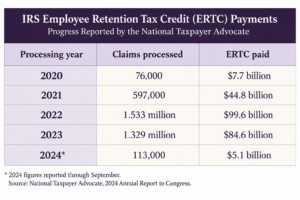
By that point, the IRS had paid approximately $242 billion in Employee Retention Credits. And where hundreds of billions of dollars go, human nature follows.
Then Some Unsavories Smelled the Money
The ERTC had begun as an emergency employment measure. It eventually spawned an industry.
Businesses were bombarded by promoters promising enormous refunds. “$26,000 per employee” became an advertising hook. Some firms charged contingency fees based on the size of the resulting credit.
The IRS became increasingly alarmed that employers were being encouraged to submit claims for which they did not qualify. Some of that concern was clearly justified. A 2024 Treasury Inspector General for Tax Administration review of more than 1.9 million processed claims identified tens of thousands of claims involving billions of dollars that exceeded IRS risk thresholds and nevertheless had not been referred for possible pre-refund examination.
The IRS had a real problem. It needed to stop improper payments without withholding legitimate money Congress had promised to employers who actually qualified. Eventually, it chose the brake pedal.

On September 14, 2023, six months after the Sisters had filed, the IRS imposed a moratorium on processing newly filed ERTC claims while it tried to separate legitimate claims from questionable ones. Processing slowed dramatically.
By October 26, 2024, approximately 1.2 million claims remained unprocessed. The National Taxpayer Advocate named ERTC processing delays the number-one most serious problem encountered by taxpayers that year, specifically citing the uncertainty and harm being caused to business owners.
There is a certain bureaucratic logic to what happened. When millions of claims arrive and some are fraudulent, stopping improper payments protects taxpayers. But there is another taxpayer on the other side of the equation: the employer who legitimately qualified and is still waiting for the government to pay.
A claim sitting in an IRS inventory for three years is a processing problem to the government. Three years can be an entire financial lifetime to a small business.
So how many businesses were approved, rejected and paid?
This turns out to be a surprisingly difficult question. Government reporting generally counts claims, rather than individual businesses, because one employer could have claims covering several payroll quarters. Consequently, there isn’t a neat federal scorecard saying: X businesses applied. Y were approved. Z were rejected. N are still waiting.
There are snapshots. There are processing statistics. There are disallowances, audits, appeals and withdrawals. But reconstructing the complete life of the ERTC from public government reporting is considerably harder than one might expect for a program of this size.
For years, even the number still waiting was enormous and sometimes difficult to pin down. That, finally, is changing.
14,900 Claims Remaining
As of just recently (the week ending August 29, 2026), the IRS reports approximately 14,900 ERTC claims remaining in various stages. The agency breaks them down this way:
- 1,650 under review
- 2,950 pending payment or disallowance
- 3,600 under audit
- 5,300 awaiting review of responses to disallowances
- 1,400 before the Independent Office of Appeals.
The IRS says it will now update those figures monthly. Think about the journey represented by those numbers. Approximately 3.6 million claims had already been processed by September 2023. Roughly $242 billion had been paid by 2024. At one point another 1.2 million claims remained unprocessed.
Today, fewer than 15,000 remain in the system. And ours is one of them.

Behind the Statistics
Behind those statistics are employers who made payroll decisions during the pandemic on the understanding that Congress had created an incentive for doing precisely what they were trying to do: keep people working. Some received their credits quickly. Others waited months. Others waited years.
Our approximately $55,000 ERTC claim was not the product of a cold call or a “$26,000 per employee” advertisement. We hired Clarus Solutions, a firm specializing in ERTC claims, to prepare our application, with its fee of approximately $12,500 contingent upon our receiving the credit. The completed package was delivered in December 2022 to Vensure, the professional HR and payroll company already responsible for our employees and payroll-tax filings.
Vensure’s legal team reviewed the package before filing it with the IRS on February 3, 2023.
We thought we had done this exactly the way a small business was supposed to do it: hire specialists, work through our established payroll company, let the lawyers review the work, and wait for the government to pay.
We are still waiting.
In Part Two, we examine what happened when one small business tried to do everything right. We hired ERTC specialists. We relied on an established payroll and HR company with legal and compliance resources. We followed the professional process. And when something went wrong, we discovered an uncomfortable truth: outsourcing compliance can also mean outsourcing control.
Nearly four years later, the payroll records and filings needed to untangle our claim remain in the hands of our compliant payroll company. We cannot fix them ourselves. And Vensure is doing nothing to resolve the problem.
Research sources
- Internal Revenue Service – Employee Retention Credit resources and 2020 vs. 2021 comparison chart
- National Taxpayer Advocate – 2024 Annual Report to Congress and ERC processing analyses
- Treasury Inspector General for Tax Administration – 2024 ERC compliance review
- U.S. Government Accountability Office – 2026 reporting on ERC processing and improper-payment oversight







Comments are closed.