



We went to Oregon to give thanks in a ceremonial way for the land and the plants and the journey that lay ahead of us. We came home with notebooks full of ideas.
One of the joys of farming is discovering that no matter how long you have been doing it, another farmer somewhere has figured out a better way to do something. Our recent trip to Southern Oregon gave us an opportunity to spend several days with growers, processors and dispensary operators — and to look closely at a cannabis market that operates differently from the one we know in California. Here are five things we learned:
#1 Oregon Has Maintained the ‘Deli’ Style of Selling Flower
In many Oregon dispensaries, flower is still sold deli-style. Large jars sit behind the counter. Customers can see the flower, smell it and decide how much they want. The budtender weighs it out at the counter. You can buy a gram from one jar and several grams from another. For people who remember the earlier days of legal cannabis, there is something wonderfully familiar about it.
California has moved heavily toward prepackaged flower. Oregon has plenty of packaged products too, but the deli model remains alive alongside them. For the Sisters, that means our Oregon launch can live in both worlds: beautiful packaged flower for people who want it and Sisters flower in jars for customers who want to see and smell the plant before choosing it.
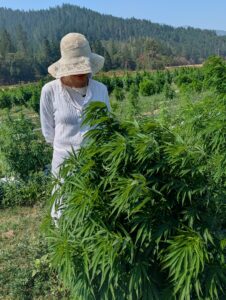
#2 Brand Parity Is Baked Into the Sales Formula
We noticed something else almost immediately. The Oregon dispensaries we visited appeared to treat their brands with remarkable parity. The daily promotional signs were a perfect example. Monday might be ‘top shelf’ day and discount only the premium flowers or oils, Tuesday might be pre-roll day and Wednesday vape pen day and Thursday gummie day . . . The promotions belong to the category rather than to whichever company had paid for the most attention.
That creates a retail environment where the budtender and the product itself have tremendous influence. For a small independent producer, that’s significant. We don’t need to be the biggest company in the room. We need to grow excellent cannabis, tell people truthfully what it is, educate the people selling it and let the product compete.

#3 The Math Is Refreshingly Consistent
Mike Beene, who works with Ryan and knows the Oregon dispensary market intimately, explained another difference to us: Oregon dispensaries generally work from roughly a two-times wholesale markup. If a dispensary pays $20, the retail price is roughly $40.
Obviously, promotions, taxes and individual circumstances can affect what a customer ultimately pays, but the underlying structure is remarkably straightforward. For growers and producers, predictable retail economics make planning much easier. Sometimes the most exciting business innovation is simply a reliable and predictable marketplace.
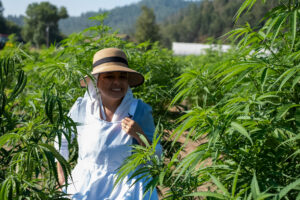
#4 We Have Been Making Some of Our Farm Work Much Too Hard
This may have been the lesson that caused the most head-shaking. Emily has spent years breeding plants not only for potency and medicinal characteristics, but for agricultural practicality. Her plants have strong stems. That means many of them don’t require the elaborate netting systems we have become accustomed to using on our California farm.
Then we started talking about harvest and processing. We have traditionally handled our hemp much like high-THC flower: cutting plants, hanging them and drying them through a fairly labor-intensive process. Emily showed us another system.
Because of the genetics she has developed, her hemp plants can be processed using methods that eliminate a remarkable amount of that work. It isn’t a universal hemp solution. The method works because of the plants themselves and the characteristics bred into them. Which may be the bigger lesson: sometimes the best labor-saving device isn’t a machine. It’s genetics.
#5 Brother Simon Needs to Come to Oregon
Ryan showed us equipment and tools he has designed and built to make large-scale harvesting dramatically more efficient. Some of the components are made using a 3-D printer. Others are clever adaptations created because Ryan needed a particular tool and decided to build it himself.
The result is a harvesting system designed so that a very small crew can process an astonishing amount of plant material. Ryan and three people, using the systems they have developed, can bring in a five-acre crop in a very short time..
The Sisters took one look at all of this and reached their own conclusion: Brother Simon must be sent north to Oregon for a bit. Simon builds things. Ryan builds things. It would be irresponsible to shirk from putting the two together, we all concluded on the drive back to California.
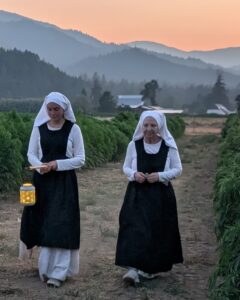
Farmers Teaching Farmers is perhaps the real lesson of Oregon. Cannabis is often discussed as an industry now — in terms of brands, regulations, margins, market share and consolidation. But underneath all of that, it is still agriculture. Someone breeds a stronger plant. Someone invents a tool. Someone discovers a faster way to harvest. Someone figures out how to dry a crop with less labor. Someone else visits the farm, looks at it and says, Why aren’t we doing that? Then they go home and do it better.
Long before there were cannabis conferences, investor decks or licensing agreements, farmers learned from other farmers. And it’s a sweet fact of life that we still do.







Comments are closed.